Nvidia's Post-Earnings Stock Performance: A Long-Term Perspective
Patience Pays: Unlocking Nvidia's Post-Earnings Potential
Immediate Reactions vs. Enduring Growth: Nvidia's Post-Earnings Trajectory
For individuals investing in Nvidia, the initial market response following an earnings report represents only a fraction of the larger narrative. Historical data indicates that acquiring the stock just before these quarterly disclosures has generally led to modest short-term profits. However, the outlook over longer periods presents a significantly more robust picture.
Visualizing Performance: A Clear Distinction in Returns
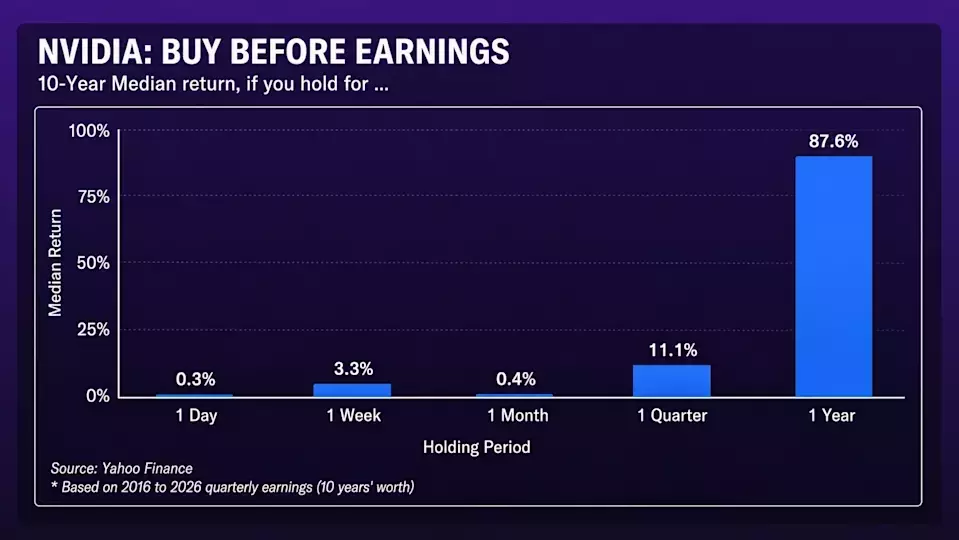
A compelling visual representation effectively illustrates this divergence in performance. The chart clearly outlines the difference in gains across various holding durations, emphasizing the benefit of a long-term strategy.
Examining Post-Earnings Returns: A Decade of Data
Since 2016, Nvidia has consistently shown positive returns across all examined holding periods subsequent to its earnings reports. Nevertheless, the immediate advantage seen over the following day, week, or even month has been considerably less pronounced compared to holding for a full quarter or an entire year. The average gain for one day stood at merely 0.3%, rising to 3.3% after a week, and 0.4% after a month. In stark contrast, these figures surge to 11.1% over a quarter and an impressive 87.6% over a year.
Navigating Market Expectations: The Role of Options Trading
This historical context helps to clarify the challenges traders encounter as they approach upcoming earnings announcements. Options markets currently predict a 6% movement after earnings, a figure notably higher than Nvidia's typical daily fluctuation during the previous quarter. Yet, this projection aligns closely with the stock's demonstrated capacity for movement around earnings in recent times.
Understanding Volatility: Nvidia's Market Behavior
The inherent volatility surrounding Nvidia's earnings is a well-established characteristic of its stock. For those engaging in short-term trading, the primary challenge lies in the unpredictability of the initial market reaction, even when the stock experiences significant swings.
The Power of Extended Holding Periods: A Strategy for Success
It is in this context that the advantages of longer holding periods become particularly evident. The sustained nature of positive returns over time underscores a key investment principle.
Enhancing Success Rates: The Impact of Time
Similar to the average returns, the likelihood of positive performance—or the win rate—improves significantly as the investment timeframe extends. Nvidia's stock has closed higher 55% of the time after one day, 60% after one week, and 53% after one month. These probabilities escalate to 78% over a quarter and 84% over an entire year.
Patience as a Virtue: The Core of Investment Success
In essence, demonstrating patience has proven to be as crucial, if not more so, than attempting to accurately predict short-term market movements.
Long-Term Trends: Unpacking a Century of Performance
A comprehensive long-term chart, spanning back to the early 2000s, reveals a crucial insight. It illustrates the rolling 10-quarter average—equivalent to two and a half years—of Nvidia's one-year post-earnings returns, demonstrating distinct cyclical patterns over time.
Adapting to Cycles: Performance in the AI Era
Nvidia's one-year post-earnings returns have moderated from their peak during the height of the AI boom, with the rolling measure decreasing from over 150% to 70%. Nevertheless, the broader trend continues to point in a consistent direction.
Rewarding Steadfast Investors: The Long-Term Advantage
Historically, the most substantial gains from Nvidia's post-earnings performance have typically been realized by investors who allowed their investments sufficient time to mature.